Making of controlled opposition
Die hemmungslose Anhäufung von Geld und Macht in den Händen einiger weniger kann für die Eliten ein Problem werden: viele Menschen finden das nämlich ungerecht. Aus diesem Grund sorgen die Reichen und Mächtigen vor und bauen Anti-Establishment-Politiker auf, deren Agenda es ist, echten Wandel zu verhindern. Diese Strategie der kontrollierten Opposition ist vor allem im Westen sehr erfolgreich, meint der Substack-Autor “Political economist”.
What the UK elections reveal about modern manipulation of democracies
Political Economist, May 31, 2026
The UK local government election results were finalised last week and, as expected, confirmed a dramatic shift in British politics. For most of the last century the UK, like the US, has had a two-party system: Labour and the Conservatives. But the election results show a fracturing of this system, with voters shifting to the Reform Party (on the Right) and Green Party (supposedly on the Left).
Reform won the most seats (1,454) in the recent elections but the most important aspect was that Reform and the Greens increased their seats by 1,890 while seats held by Labour and the Conservatives decreased by 2,061.
The overall implications are shown in estimates of how this would translate into national elections:
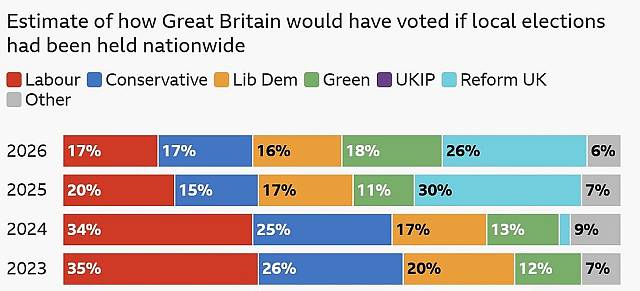
Extrapolating the local results to the national level suggests that Reform would be the largest party, followed by the Green Party: upending the system in which the Labour and Conservative parties once dominated.
Unlike the US, in the UK the Labour Party was responsible for implementing policies that were meaningfully different from its Conservative counterparts: the National Health Service is an iconic example. So that division was not just a matter of branding, as has often been the case with the Republicans and Democrats. At least that was the case, until Keir Starmer became leader of the Labour Party in 2018 and shifted Labour dramatically to the Right.
The dominant narrative, in the mainstream and ‘alternative’ media, at the moment is that these voter shifts reflect actual democratic dynamics: dissatisfied with the two traditional alternatives (Conservatives and Labour) voters have moved further towards the ‘extremes’ of the spectrum. The winners are the right-wing Reform party and the supposedly ‘progressive’ Green Party.
It’s one of those arguments that creates a persuasive narrative but, as with many others that I write about here, it is deeply misleading. It frames what is likely a carefully coordinated strategy as simply organic: the inevitable outcome of a series of natural, unmanipulated events.
The question that arises is: if the destruction of the two-party system in the UK is a deliberate, coordinated effort, why is this being done?
Before answering that question directly, it’s useful to take a closer look at the leaders of the two key parties attracting voters away from the traditional options.
In my previous article I explained that the leader of the supposedly now left-wing Green Party is quite clearly a fake, manufactured progressive. His own personal and professional history shows that. It is only his recent ‘branding’ in the last two years that has framed him as a principled, anti-establishment progressive (or even radical).
Political sentiment in many of the world’s most powerful democracies appears to have shifted rightward. At the same time, with the economic effects of the Covid-19 pandemic and the rapid development of artificial intelligence, wealth and power is becoming even more concentrated among a small elite. That leaves a vacuum on the left of the political spectrum, which could ultimately be a threat to that same elite. It is, after all, the Left that has the most intellectual and political substance to confront these developments and potentially achieve real structural change.
The other leader, of Reform UK, is Nigel Farage — who has already played a pivotal role in destabilising British politics by leading the UK’s exit from the European Union.
Nigel Farage: a usefully unremarkable man
The last time Nigel Farage had a significant impact on British politics was when he successfully led the movement towards ‘Brexit’: the UK leaving the European Union. The UK formally left in 2020 following a referendum in 2016 in which 51.89% of voters supported the proposal to leave with a turnout of 72% of eligible voters. Farage and his collaborators achieved this despite winning little support in actual national elections: Farage’s party won no seats in the 2019 national elections and 1 in the 2024 elections. It was a single issue victory, but one with huge ramifications not just for the UK but for Europe as a whole.
Initially, Farage advocated for Brexit (as it became known) as leader of the UK Independence Party (UKIP) — then subsequently under the banner of the Brexit Party, which was renamed Reform UK in 2021. The Brexit decision has had few discernible benefits for the UK, but many discernible costs.
I have my own theory about what was really behind the movement, which had the effect of splitting the UK off from Europe in order to secure its status and usefulness as a cross-Atlantic ally of the United States. It is important to remember that the UK is the second-most important member of the Five Eyes international mass surveillance network, besides the United States, exposed by Edward Snowden.
For the moment it is just interesting to note that Farage has been a useful figurehead, for the second time now, to structurally weaken the United Kingdom as a country and upend its politics.
Through Brexit, the UK was split off from its European allies. And now through the disruption of the established parties by the Reform-Green combination, Farage is playing a key role in also weakening the UK’s ability to elect a party that can determine and pursue its national interests and principles in a consistent, cohesive and genuinely independent way.
Unlike Polanski, Farage himself has been very consistent in his political and social views. Various accounts suggest he was right-wing from his school days, likely taking after his stockbroker father. Farage himself also became a stockbroker and was initially a member of the Conservative Party for almost a decade. He appears to have become preoccupied with opposition to Britain’s membership of the EU as part of fringe, right-wing political groups in the late 1980s and early 1990s.
An objective assessment of Farage is that he is a remarkably unremarkable man: uncharismatic, shallow, and elitist. In that sense, comparing him to someone like the boorish former prime minister Boris Johnson, he would have fitted in well in the Conservative Party. Like many Conservative leaders, his complete lack of charisma or genuine vision have been compensated for by extensive support from right-wing and centrist media. A notable aspect of this has been turning Farage’s apparent enjoyment of a ‘pint’ (of beer) into an ‘ordinary man’s man’ brand.
One study, which did not adopt a particularly critical lens, found that even the public broadcaster (British Broadcasting Corporation) had featured Reform on up to 25% of its news broadcasts in 2025 leading up to the local elections in that year. While the study focuses on similarities and differences in coverage to another opposition party (the Liberal Democrats) and the apparent scrutiny of Reform, it fails to address an obvious question: why should 25% of news broadcasts feature a party that in three national elections won at most 5 seats out of a possible 650?
A similar dynamic occurred with Brexit, with major media outlets in the UK giving extensive coverage to Farage and the proposal, which ultimately served to facilitate it happening. Analyses of that reveal a similar theme to one that I find recurring in my own analysis: the ‘dramatic’ rise of unremarkable individuals with dubious backgrounds who are positioned as anti-establishment — whether from the ‘Left’ or from the ‘Right’ of the political spectrum.
In other words, Farage is arguably less a ‘leader’ than a useful figurehead or placeholder whose political successes are determined by those that determine media coverage. I have already described how Polanski’s dramatic political success of the last year has been similarly determined. So the real question is: what is the bigger strategy, if any, behind this shift?
Why it became necessary to upend UK democracy
Here is a brief theory of why this is happening.
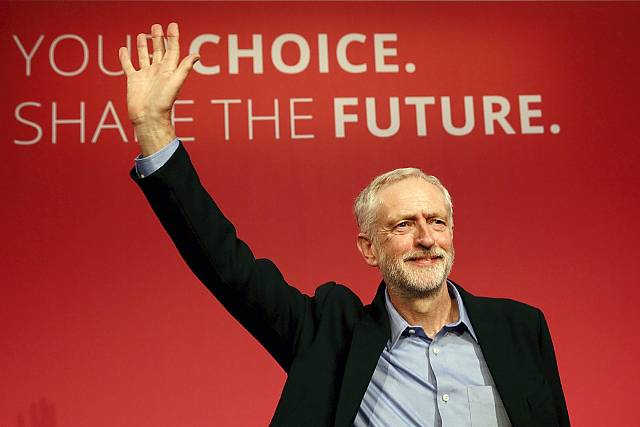
Recent developments in British politics are driven by a backlash against ‘Corbynism’: the genuinely organic rise in popularity of a genuinely progressive leader (Jeremy Corbyn) who for a brief period was leading contender for the position of UK prime minister. This amplified the pre-existing fear in North America about the direction that the European Union was taking the UK, its most important international ally. That, in my view, is what was really behind Brexit.
The level of hysteria that Corbyn then generated in the UK establishment shortly after Brexit had been ‘secured’ cannot be exaggerated: it reached an apogee with various UK media outlets publishing implied threats from military and intelligence sources that they would ‘not allow’ Corbyn to be prime minister. In essence, they directly implied that Corbyn might be killed or that there might be some form of coup. This has been systematically documented by, and noted in, multiple analyses.
There are many reasons the Anglo-American establishment feared a Corbyn victory: too many to even list here. Historical evidence of UK and US intelligence services⁶ suggests it is very likely Corbyn has been under surveillance by Western intelligence agencies for much of his career: as prime minister he would get access to those files and discover who in his inner circle were actually working for those agencies. At a larger, related scale, Corbyn was opposed to the excess expenditure on militarism and surveillance: a direct threat to the mini-empires of those at the top of these institutions, the companies that profit from them, and of course the broader web of interests and geopolitical control that they serve. In the economic realm, Corbyn wanted to move the UK back towards a more traditional Labour, social democratic model with higher taxes on the rich and large corporations, an expansion of the state and provision of public services. That was a threat to the billionaire class and the cliques it sustained.
Although Corbyn was ultimately defeated by the massive propaganda campaign mobilised against him, in combination with various kinds of sabotage from inside his own party, he demonstrated that the British public could be mobilised to back a genuinely progressive candidate. That was a ‘threat’ to the cross-Atlantic establishment that it would have felt needed to be neutralised more thoroughly than simply by blocking Corbyn once. The Conservative Party and the neoliberal wing of the Labour Party (often referred to as the ‘Blairites’) had already shown they were incapable of doing the job by ‘letting’ Corbyn get so close to victory and fielding a series of uninspiring opponents.
The alternative to relying on those long-standing institutions was, instead, to:
1. Shift the political spectrum to the right by shifting Labour to the right and promoting a candidate to the right of the Conservatives — this has been implemented with Keir Starmer and Nigel Farage
2. Draw support away from Corbyn to ‘safer’ leaders — this has been implemented by manufacturing and amplifying a fake progressive (Zack Polanski) and through again sabotaging Corbyn internally (in the newly formed Your Party)
3. Fracture the system to make it harder to get voters to coalesce around a genuinely progressive alternative — this has been achieved by amplifying and promoting Polanski and Farage.
The 2026 local election results in the UK are the fruits of this strategy.
Its implications, however, reach far beyond the UK. It shows how and why democracy is manipulated by deeper interests within and across societies, along with the pivotal role played by the media and social media. It is a sobering case study, but a crucial one for anyone who still believes in pursuing real democracy.
The new generation of fake leftists: from Zohran Mamdani to Zack Polanski
Political Economist, May 06, 2026
Political sentiment in many of the world’s most powerful democracies appears to have shifted rightward. At the same time, with the economic effects of the Covid-19 pandemic and the rapid development of artificial intelligence, wealth and power is becoming even more concentrated among a small elite. That leaves a vacuum on the left of the political spectrum, which could ultimately be a threat to that same elite. It is, after all, the Left that has the most intellectual and political substance to confront these developments and potentially achieve real structural change. To pre-empt that, these interests appear to have invested heavily in creating fake left-wing leaders and organisations.
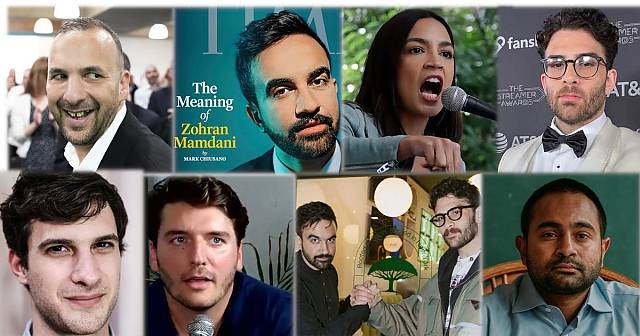
Here is a list of some individuals in the United States and United Kingdom: Zohran Mamdani, Zack Polanski, Alexandria Ocasio-Cortez, Hasan Piker, James Schneider, David Adler, and Jackson Hinkle. Some notable fake leftist organisations include Democratic Socialists of America, the Progressive International, Jacobin, and the American Communist Party. And of course fake progressive media outlets like Zeteo (US) and Novara Media (UK), along with their fake progressive founders like Mehdi Hasan and Aaron Bastani.
All of the individuals and institutions are likely the creation of a pre-emptive strategy by intelligence agencies, and associated elites, in these two countries to control the Left of the political spectrum. A crucial part of that is a very specific propaganda strategy that serves to promote many of these individuals to the general public while establishing their apparent radicalism or progressiveness. I refer to that as Propaganda 2.0.
Propaganda 1.0 is what most people understand propaganda to be: direct or subtle promotion of a particular position. Consider the case of propaganda on behalf of Israel. In some forms it involves newspaper articles claiming that Palestinians receive equal treatment in Israel, that Israel is fully democratic, and only uses violence in self-defence. In other cases it uses more subtle tactics, recruiting people to act as (seemingly) independent influencers, manipulating social media content, and so forth. Even in its most subtle form, these are still very basic tactics.
Propaganda 2.0 is much smarter and counter-intuitive, which is why it works so well and is so crucial to manufacturing fake progressives and fake radicals in the modern era.
In this article I briefly outline how Propaganda 2.0 works, and then I discuss how it has been used to manufacture the likes of Zack Polanski in the UK - who has moved from being almost unknown to being a leading political contender in less than a year. Over the last few months, the same kind of tactic has been used to promote the ‘Twitch streamer’ Hasan Piker in the USA. Last year it was Zohran Mamdani. Before him AOC. And flying a little more below the radar, the likes of James Schneider who is now at the Progressive International but previously infiltrated the political movement of Jeremy Corbyn which nearly toppled the British establishment.
Unless there is more widespread awareness of this strategy, and who the fake leaders are, existing systems of power will be able to maintain themselves indefinitely. This is ‘controlled opposition’ in its realest form. Why fake left-wing leaders? Take a look at the graph below: 39% of Americans now have a positive view of socialism compared to 54% who have a positive view of capitalism.
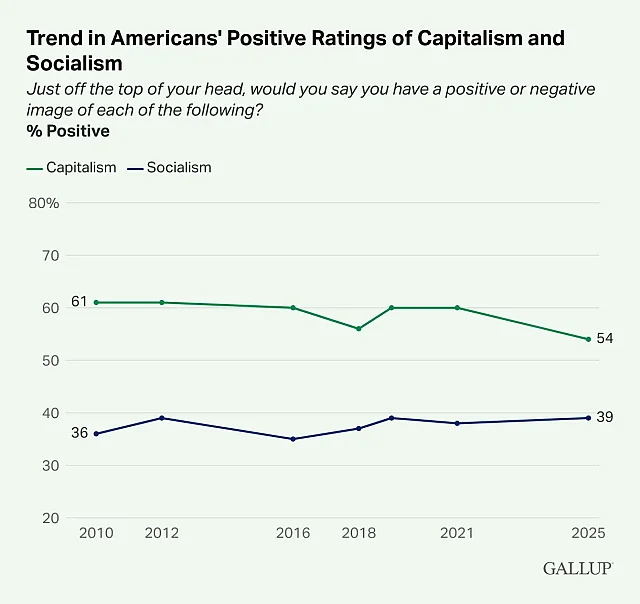
All you would need, if the United States was democratic (its not), would be a high turnout of that 39% and a low turnout of the 54% and a revolution of sorts could happen tomorrow. Herein lies the motive for the US establishment and its ‘deep state’ counterparts to manufacture fake left-wing politicians: if such a scenario does materialise, they will remain in control through such proxies.
Pattern recognition, understanding and prediction
Political Economist, Jan 26, 2026
In my early teens I was a decent school-level chess player, but my skill and achievement plateaued quite quickly. Our coach encouraged us to study chess books and positions but it seemed boring and I couldn’t see the point. Only many years later did I read about why studying past games is so important: pattern recognition.
There’s too much going on in the world to conduct detailed analysis of every important issue, event or person. Fortunately, we don’t need to: by engaging with deeper dynamics and learning to spot patterns, we can shortcut the process of understanding what’s going on. Pattern recognition is what chess players use at the highest levels, because it substitutes for the processing power required to think many moves ahead: once you see a particular combination of moves or position, you can know the exact moves needed to win the game or bring it to a conclusion without having to calculate them from scratch.
Although human affairs are more complicated and probabilistic (rather than deterministic), a similar principle applies. Whether it’s ‘2D’ or ‘3D chess’, as sophisticated strategy is referred to on social media these days. True novelty1 is extremely rare: the vast majority of occurrences around us have corollaries in the (near or distant) past, or are generated by dynamics that have been in play for some time and produced other such occurrences. So to paraphrase Keynes, as I did when I started this Substack: to understand the future we need to analyse the present in light of the past.
What I aim to do in my articles here is to share an understanding of crucial geopolitical and political economy issues, informed by the patterns I have observed and learned over time. I am not a historian and though I have great respect for competent, critical historians I have no desire to be one. I am interested in history because I am interested in understanding the world now and into the future, and that is the only kind of historical reference you will read here.
These kinds of patterns apply not only to the grand pronouncements of presidents and prime ministers (like Mark Carney’s recent visit to China and speech at the World Economic Forum) and the geopolitical strategies they put into play, but also the more microscopic behaviour of individuals and how they are aggregated on social media platforms. In my last two posts I explained why the hype around Mark Carney’s visit to China was misleading, and sketched a theory as to why a suddenly viral social media geopolitics commentator is probably a CIA creation. In neither case am I actually that interested in the individuals, or even the events, but rather their relevance to far bigger issues. If it wasn’t Carney giving those speeches it would have been someone else (probably my ‘fellow’ Rhodes Scholar Chrystia Freeland - more on her later in the year). If it wasn’t Jiang Xueqin likely occupying a large chunk of the geopolitical commentary space for a Western intelligence agency it would have been someone else: because such interests need to fill these spaces to prevent actual independent and critically minded people from doing so.
I had already written that available evidence about Tucker Carlson’s earlier life suggests he too is probably a CIA plant, doing the same work his father used to do but in the modern world where social media platforms are the ‘new media’. And I raised concerns about Glenn Greenwald’s silence as two key figures from the ‘alternative media platform’ he promotes were appointed as deputy directors of the FBI and CIA. As ‘ordinary citizens’ we are discouraged from knowing obvious facts (like Carlson applying to the CIA, or Xueqin having been arrested as a spy, or indeed Barack Obama’s first job being at a CIA front organisation) and seeing their most likely implications for what they are. We are instead told that this is ‘conspiracist thinking’, as if conspiracies are not happening all the time (see also the simple explanation by the recently deceased historian and political scientist Michael Parenti).
One of the most challenging things about the present moment is that those who have the power to put global strategies into play, also have unprecedented power to control and manipulate our understanding of those strategies. While we also have unprecedented access to information, what matters is what information is accessed and how it is understood and interpreted. In addition to their functionaries in the media cultivated over many decades, those in power have now also cultivated or created functionaries in the social media space. And they have influence or control over the mechanisms by which those platforms operate.
The ‘smoke and mirror’ games that have been played for centuries have now, literally, been amplified to the Nth degree. While most of the discussion about platform manipulation (including what is considered ‘cutting edge’ research) is concerned with ‘bots’ and AI-generated bot swarms, I argued years ago that the real danger is more subtle, more powerful and much harder to detect.
In my forthcoming posts this year I will be covering specific geopolitical issues like the quasi-coup in Venezuela, Trump’s seemingly bizarre tariffs, the attempted overthrow of the government (‘regime’) in Iran, what is going on internally in the United States, what is happening in UK politics and why understanding it is so important, whether the ‘collapsing dollar hegemony’ narrative makes sense, the real situation with France’s global influence and Emmanuel Macron, what is happening in South America, and more supposedly progressive, radical or critical individuals in the social media space who are not what they seem. In my view, understanding and truth need to precede action, but I will also say something about possible solutions to the situation we find ourselves in and how the ‘deep state’ can be reined in.
Meanwhile, in South Africa the scandals and inquiries are almost impossible to keep up with. I will be writing about the assassination of a DJ who linked alt-right political influencers to minibus taxi mafias, the alleged former MI6 operative who embedded himself in South Africa’s criminal justice system and became associates with an anti-apartheid activist who was subsequently appointed as the head of the country’s foreign intelligence branch, the supposedly radical communist political party that Trump showed videos of in the Oval Office whose office-bearers are not what they seem, and much more.
If you’re a new subscriber (welcome!) it might be helpful to know about some arguments I have made previously that I will be applying as lenses to understand many of these issues:
- The US empire is not in decline, it is in fact in ascendance
- Linked to that: BRICS has been co-opted by the United States, to become a covert tool rather than the threat it once was
- South Africa’s ICJ application on Israel was likely greenlit by the Biden administration and the apparent hostility between RSA and the USA does not extend to the deep state level
- South Africa’s 2024 election results were probably manipulated or rigged and covert US influence may be the most likely reason those elections led to a gangster being appointed to the South African Cabinet
- Trump is a genuine annoyance to the US establishment/deep state but he is being managed [important: this is not saying Trump is in any sense good
- Palantir deserves the title of the world’s most evil company and is emblematic of the dystopian future looming before us
- Conspiracy theorising is necessary and rational: “if you are not a conspiracy theorist then you are an idiot”.
Since my main aim is to provide analysis that helps people figure out the truth and what’s actually going on, the majority of my posts are not paywalled.
Nevertheless, writing and research is time-consuming and support means that I can devote more time to this. I paywall articles on using political economy insights for share investing, some where I summarise the main conclusions at the outset but the meat of the analysis is in the paywalled sections, and some posts where I give paid subscribers insight into issues that I will publish in unpaywalled posts later in the year. So whether you want early and extra access to content, or you just find my analysis useful: if you are financially able to do so, consider subscribing or buying me a coffee.
One thing I can guarantee is that you will get an informed perspective here that you will get nowhere else. Whether you agree or disagree remains, of course, entirely up to you.
Thanks for reading.

A brief note on 'conspiracy theories' and ‘conspiracy theorists’
Political Economist, Feb 13, 2025
For a few decades it has been popular among people who consider themselves intelligent centrists to use the terms ‘conspiracy theory’ and ‘conspiracy theorist’ as pejorative put-downs. Intuitively, however, this seems quite ridiculous because in reality conspiracies are widespread in all domains of society, from the family level where people conspire to cheat relatives out of inheritance money to the national level where one government uses its covert agencies to overthrow another government (militarily or in a ‘silent coup’).
What most people who use this rhetorical strategy are unaware of, is that the intuition that ‘ordinary people’ have is backed up by a substantial literature in philosophy. A range of philosophers have pointed out that it is incoherent and/or undesirable to use the term ‘conspiracy theory’ in an inherently pejorative way. There are logical, rational and well-founded ‘conspiracy theories’ and there are illogical, irrational and baseless ‘conspiracy theories’. So when we discuss conspiracies we should rather be focused on the merits of the theories, reasoning and available evidence, rather than disparaging the notion that a conspiracy could exist at all.
A lot of my writing here involves exposing dynamics that are concealed from the general public, whether in South Africa, the United States or globally. Sometimes that is the result of a deliberate conspiracy among powerful elites — something that has been happening throughout human history. Other times it is due to a more organic coalescing of vested interests backed up by power and influence. One could call those ‘conspiracy theories’ and in many instances I would not have a problem with that provided it is used as a descriptive term rather than an inherently pejorative one.
The US economist JK Galbraith coined the term ‘the conventional wisdom’ to refer to beliefs that are really a consequence or construct of powerful interests. Noam Chomsky and Edward Herman famously described how mass media engage in ‘manufacturing consent’. When those outside the various cliques of power put forward explanations for what is really going on — not what the conventional wisdom or manufactured consent concludes — the term ‘conspiracy theory’ or ‘conspiracy theorist’ has been a useful way of smearing that alternative analysis even (or especially) when it is correct.
What has also become apparent is that conspiracy theorising is entirely acceptable when it involves certain people or certain issues. For example, it is remarkable how many people who generally disparage ‘conspiracy theories’ believe the attempted assassination of Donald Trump was fake — despite live footage from multiple angles and at least two dead individuals (the assassin and a member of the crowd). The same people believe that there really was a serious conspiracy to overthrow the US government on 6 January 2020 and that Trump was (is) controlled by Vladimir Putin due to Russian ‘kompromat’.
In fact, many such people will believe almost any conspiracy about Russia or China provided it is peddled by ‘mainstream’ media outlets — so that even when an apparent weather balloon blows off course it is the subject of ‘spy balloon’ hysteria for weeks. (Interestingly, the spy balloon hysteria has just been revived shortly after Trump took office). But they will deny even the possibility of conspiracies by, for example, the Obama administration funding ‘soft coup’ attempts in uncooperative countries — even in the face of significant evidence.
I am open to the possibility that the Trump assassination was staged, but based on the available evidence it seems much more likely to have been real. Moreover, it seems that if there was a deeper conspiracy than merely the motives of the individual in question, it would more likely be on the side of those facilitating the assassination attempt. Almost all experts interviewed on the subject agree that the security failings on the day were extreme and unprecedented. But that is a sensible discussion one can have. The point here is that beyond being logically and intellectually incoherent, the use of ‘conspiracy theory’ as an insult or disparagement is also highly politicised.
In short: it is best not to waste time on the disingenuous rhetorical strategy in which people disparage analyses they don’t like as ‘conspiracy theories’ or people they don’t agree with as ‘conspiracy theorists’. There are many true conspiracy theories and many knowledgeable conspiracy theorists. Any intelligent person must be a conspiracy theorist — or as philosopher Charles Pigden says, “if you are not a conspiracy theorist then you are an idiot”.
Ultimately, what we need to do is try and establish the truth as best we can in an environment where those with power often have strong incentives to conceal it.