Journalism at its best
Abseits der gleichgeschalteten westlichen Medienmaschinerie hat sich in den sozialen Netzwerken eine Journalistenszene etabliert, die - neben der handelsüblichen Propaganda - Information und Analyse bietet. Eine der interessantesten Plattformen ist das 2017 gegründete Substack, auf der internationale Autoren Texte, Podcasts und Videos publizieren - die meisten Inhalte sind gratis. Die vier folgenden Artikel erschienen Mitte Februar 2026.
The Empire Above Epstein
How the Epstein scandal points to the real hierarchy of power
Kevork Almassian
Feb 11, 2026
When I read the latest batch of Epstein emails, I had the strange feeling that the story was getting bigger in the serious sense that it starts pushing you toward questions that are normally considered too heavy for polite conversation: who really rules, who owns the money, who sets the limits of what is possible, and why the world often feels like it is being managed from above while the rest of us are simply reacting from below.
And I want to start this op-ed with a disclaimer, because in today’s environment people either want you to speak with religious certainty or they want you to shut up, and I reject both of those demands; I’m going to be careful with my words, I’m going to raise controversial ideas, and I’m going to tell you openly that some of what I’m about to say is speculation, not because I want to hide behind a hedge, but because anyone who speaks about these networks honestly has to admit where the evidence ends and where interpretation begins.
For years, you’ve heard people say “we’re ruled by satanic cults,” and I have always been skeptical of that framing, not because I think the world is morally pure, but because I don’t accept extreme claims without proof; however, what I have always said—long before these documents—is that the people who dictate foreign policy, who start wars, who impose starvation sanctions, who can look at the suffering of millions and call it “strategy,” must have a certain psychological profile, because normal human beings do not casually destroy entire societies and then sleep well at night.
And if you think that’s an exaggeration, just look at the way sanctions operate as a weapon. In the United States, most people have food on the table, and yes, there is poverty and injustice in America, but you have families outside America that cannot afford bread for their children, cannot afford milk for a newborn baby, and the Western public is trained to believe this is always the result of local corruption or local mismanagement, but we both know, if you’ve been following my work on Syria, that U.S.-led unilateral coercive measures —illegal economic sanctions— are employed as a tool of war, and they are designed to break societies until they submit.
Syria is the clearest example because the record is not even disputed: after Donald Trump’s sanctions—especially the Caesar Act—Syrians were pushed under the poverty line on a mass scale, and we are talking about millions of people living inside the country who watched their currency collapse, their purchasing power evaporate, and their society suffocate economically even after the major battles quieted down.
Now, here is where the Epstein emails begin to change the way you perceive the world, because for years we assumed that the people making these decisions were the visible institutions: the White House, Congress, the Senate, the Department of Defense, the Department of Justice, the intelligence agencies; we assumed those were the rooms where policy is made, and maybe they are—partly—but what these leaks invite you to consider is that even those institutions may not be the top of the pyramid, that beyond presidents, beyond politicians, beyond the faces you see on television, there might be stronger forces that finance, incentivize, and guide the decisions, and that the visible leaders are sometimes executors rather than masters.
Because once you start reading about the relationships around Epstein—who he met, who he advised, who he had access to, who he was bragging about representing—you begin to see something like a web, a connected network of money, ideology, and bureaucracy, where the same names show up across finance, tech, academia, and politics, and you begin to suspect that what we call democracy might be more like a stage: a circus of competing politicians who look like leaders but function, in reality, as employees of a system they do not control.
I say this not to sound melodramatic, but because the implication is deeply unsettling: if power is operating through networks we cannot see directly, then what is the meaning of elections, parliaments, campaign promises, televised debates, and moral posturing? Are we truly choosing our future, or are we being offered a menu where the real chef remains hidden, and our only role is to select which dish will be served to us this season?
This is where the names that appear around Epstein start becoming more than gossip. The point is not to worship or demonize a single family or a single dynasty, and I want to be clear here because the internet loves turning analysis into tribal targeting; the point is to understand that banking dynasties, military-industrial interests, and elite tech projects are not separate universes, they are often intertwined, and when you see Epstein telling people that he represents major banking interests, and when you see the proximity between Silicon Valley billionaires and networks like his, you start thinking that many of the “visionary” projects sold to the public—transhumanism, brain chips, AI governance, digital currency systems—might not be grassroots innovations at all, but top-down projects in search of total control over the human environment.
And when you think about it this way, you begin to question the entire hierarchy of power. Maybe parliaments are not the first level of decision-making, but the fourth or fifth. Maybe prime ministers and presidents are not sovereign leaders but third-level managers, tasked with selling policy to the public. Maybe the Musk and Thiel class—those who run platforms, build AI systems, push neural technologies—are not the top either, but executive directors implementing projects designed elsewhere, for interests larger than their own.
And then you arrive at the most dangerous question of all, the question nobody wants citizens to ask too loudly: if the real power lies above the democratic stage, in darkness, in networks that can feed money, push ideas, and mobilize bureaucracy to implement them, then do we really live in democracies, or do we live inside managed democracies where freedom is mostly a feeling, and choice is mostly a performance?
This is where the modern agenda begins to look less like progress and more like a trap. Digital IDs. Central bank digital currencies. A future of permanent verification. A future where every transaction, movement, and social interaction can be registered, controlled, and possibly punished. Even public health itself, something that should belong to medicine and care, becomes a domain of discipline and enforcement, where you are told that you must comply not because the science is settled but because the system has decided that dissent is intolerable.
And people will ask: Do we have a choice? Are we truly able to say “no” if these systems are being built regardless of what voters think? Because if these projects can be imposed even against public skepticism, then democracy becomes a branding exercise rather than a governing reality.
What has changed for me since this recent Epstein drop is not that I suddenly discovered evil exists, or that powerful people lie; what changed is that the veil feels thinner, and the hierarchy feels clearer, and the idea that politicians are “leaders” feels harder to maintain. When someone like Tony Blair—who played an instrumental role in invading Iraq—comes back years later and tries to sell the public the need for digital IDs, I see him as an employee, a middle manager, implementing the projects of superiors whose names we rarely see on the screen.
And perhaps this is the real geopolitical significance of the Epstein emails, beyond the depravity, beyond the scandal, beyond the sensationalism: they force you to confront the possibility that the world is governed by networks, and that those networks are more durable than governments, more influential than elections, and more insulated than any official institution will ever admit.
I am not asking you to accept a single grand theory. I am asking you to notice the pattern, and to ask yourself whether the pattern explains why the world feels increasingly unfree, increasingly managed, increasingly engineered, even as we are told, with straight faces, that we live in the most democratic era of human history.
If this is where we are headed—toward a future of digital control layered on top of economic exhaustion and manufactured crises—then the only serious question left is not “who will win the next election,” but whether ordinary people can recover enough clarity, unity, and courage to reclaim a political life that is not scripted from above.
Because if we are reduced to permanent reaction—always reacting to the next war, the next crisis, the next manufactured panic—then we are not citizens. We are subjects.
And maybe that is the most mind-boggling part of all: that the Epstein story, which began as a sordid scandal, ends by forcing us to ask whether the civilization we live in is still what it claims to be.
Kevork Almassian is a Syrian geopolitical analyst and the founder of Syriana Analysis.
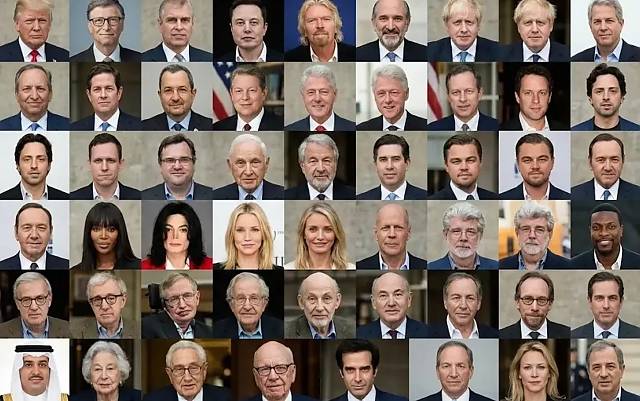
They Called Rotherham a "Muslim Problem" — What Do They Call Epstein's Island?
Where's "Race" When Discussing the World's Most Notorious Grooming Gang?
BettBeat Media
Feb 16, 2026
The release of the Department of Justice files on Jeffrey Epstein has confirmed what the victims always said — that a network of extraordinarily wealthy and powerful men raped children with impunity for many decades, shielded by prosecutors, intelligence agencies, and the velvet machinery of class. The files have given us names, dates, flight logs, and email exchanges so depraved they read like evidence from a civilization in terminal moral collapse. And yet, in the great churning of American media, one dimension of this case remains almost perfectly untouched: race.
This silence is itself a confession.
We know what happens when predators are brown — or rather, when predators are perceived to be brown. When grooming gangs in Rotherham and Rochdale were exposed in Britain, the discourse was immediate, racialized, and totalizing. The crimes were not treated as the acts of individual men. They became proof of a civilizational pathology — Islam itself was put on trial. Commentators who had never read a word of the Quran suddenly became authorities on the Prophet’s marriage to Aisha. The ethnicity of the perpetrators was not incidental; it was presented as explanatory. Their culture produced them. Their religion demanded it. An entire people was made to answer for the crimes of specific men.
There was only one problem with this narrative: it was built on a lie.
90% Were White
The Home Office’s own 2020 research review found that group-based child sexual exploitation offenders are “most commonly White.” A 2024 report by the Centre of Expertise on Child Sexual Abuse found that where ethnic background was recorded, ninety percent of offenders were white, five percent were Asian, and two percent were Black. The Ministry of Justice’s own prosecution data shows that eighty-eight percent of defendants prosecuted for child sexual abuse offenses in England and Wales were white — a figure that slightly exceeds white representation in the general population. UCL researchers, reviewing the Home Office data, declared that “a powerful modern racial myth has been exploded. What started as a far-right trope had migrated into the mainstream.” The same report admitted that “grooming gangs are not a ‘Muslim problem.’”
The machinery of racialization did not merely distort the story. It inverted it. A phenomenon that was overwhelmingly white was rebranded as a Muslim problem, and an entire community was indicted on fabricated demographic grounds. The few who dared say otherwise were silenced. In September 2025, at a far-right rally in Hull, a survivor of child sexual exploitation took the stage to tell the crowd that the men who had groomed and raped her were not Pakistani immigrants but white Englishmen. She was booed. She was physically pulled from the stage. “I am disgusted with all of you,” she told them. The crowd did not want her truth. It wanted its myth.
When the perpetrators are wealthy, white, and Western, the interpretive framework transforms completely. Suddenly we are in the realm of abstraction. The conversation becomes about “power,” about “masculinity,” about “capitalism,” about “systems.” All valid categories of analysis — but deployed here with a conspicuous selectivity that should trouble anyone paying attention. The racial identity of the men in Epstein’s orbit does not appear in the analysis. It does not hang over the story the way “Muslim” or “Pakistani” hung over Rotherham. The perpetrators are granted what minorities in the dock are never granted: the luxury of individuality, the presumption that their crimes belong only to them.
Sexually Assaulting the Goyim
The Epstein files make this evasion harder to sustain. The documents released by the DOJ reveal not merely a sex trafficking operation but a window into the ideology of the man at its center. Epstein, in his own correspondence, was not shy about articulating a racial worldview. He wrote to the cognitive psychologist Roger Schank about how “the jew make money” while letting “the goyim deal in the real world.” In emails to the publicist Peggy Siegal, arranging guest lists for parties that doubled as procurement operations, he described attendees as “goyim in abundance — jpmorgan execs brilliant wasps” — a taxonomy that sorted human beings by ethnicity as casually as a sommelier sorts wine by region.
He distributed DNA kits, fixated on haplogroups, and spoke to the survivor Maria Farmer about his Ashkenazi genetic lineage in terms of superiority and evolutionary fitness. Ghislaine Maxwell reportedly reinforced this framework, mocking Farmer’s “white girl’s” heritage. The New York Times documented Epstein’s plan to impregnate as many as twenty women children at his New Mexico ranch — a eugenics project dressed in the language of philanthropy.
These are not peripheral details. They are the documented ideology of the principal predator.
Now imagine a Muslim sex trafficker who had written emails sorting humanity into believers and infidels, boasting of Arab genetic superiority, and running a breeding program on a private compound where he sexually abuses inferior “white girls”, there is not a newspaper in the Western world that would fail to put his ideology at the center of the story. It would be the story. Cable news would convene panels on Islamic supremacism. Think tanks would publish reports. Legislatures would hold hearings. The entire apparatus of the War on Terror would re-activate with renewed moral certainty.
But Epstein was not a Muslim. He was a white Ashkenazi Jewish man of extraordinary wealth moving through the most elite corridors of American and European power — a man who, in his own emails, distinguished himself from the 'goyim' and mocked the non-Jewish heritage of his victims. And so the racial framework evaporates. His ideology becomes a quirk, a footnote, an embarrassment to be managed rather than a data point to be examined.
This is not a call to indict a people for the crimes of individuals. That logic is precisely what was wrong when it was applied to Muslims in Rotherham, and it would be equally wrong applied to anyone else. The point is the opposite: the framework should be consistent. If we are to discuss the racial and cultural dimensions of crime — and serious people disagree about whether we should — then the discussion cannot apply exclusively to the powerless.
If the ethnic identity of Pakistani grooming gangs is relevant, then the ethnic identity of the men in Epstein’s circle is relevant. If it is not relevant for Epstein, then it was never relevant for Rotherham. You cannot have it both ways, and the fact that mainstream discourse does have it both ways reveals that the function of racialization was never explanatory. It was disciplinary. It was a weapon aimed downward — Indeed, the exact reason why racism was invented in the first place.
The Structural Racism of Sexual Abuse
There is a deeper structure here that demands examination. The concentration of extreme wealth in the West is not racially neutral. The men who sat at Epstein’s table, who flew on his planes, who visited his island — they were not a random cross-section of humanity. They were drawn from the upper echelons of a global financial system whose commanding heights remain overwhelmingly occupied by two overlapping demographics: white men of mostly Christian heritage and white Ashkenazi Jewish men. This is not conspiracy. It is demography.
The racial composition of extreme wealth is itself a product of history — of empire, of colonialism, of slavery, of exclusion. And when that wealth provides the infrastructure for predation — the private islands, the shell companies, the armies of lawyers, the compliant prosecutors — then the relationship between race, wealth, and impunity becomes a legitimate subject of inquiry. To refuse to discuss it is not neutrality. It is protection.
And here, two off-ramps present themselves — both well-worn, both convenient, both dishonest.
“It’s the Jews!”
The first belongs to the white establishment. When the evidence points toward elite networks of abuse, there is always a faction eager to make it about “the Jews” — to treat Epstein’s Jewish identity as the explanation rather than a feature of a much larger architecture of power. This deflection has a long and ugly pedigree. It allows white Christian America and white Christian Europe to launder centuries of colonial predation, slavery, and systemic abuse behind the convenient figure of the Jewish scapegoat.
The British Empire did not need a single Jewish conspirator to build its machinery of global exploitation. The Catholic Church did not need one to shield generations of predators in its ranks. The plantation class did not need one to rape enslaved children with legal impunity for hundreds of years. To reduce elite predation to a Jewish problem is to grant white power the most extraordinary amnesty in history.
“It’s an Anti-Semitic Conspiracy”!
The second off-ramp belongs to the Zionist establishment. When Epstein’s own emails surface — “how the Jew make money,” “let the goyim deal in the real world,” the mockery of Maria Farmer’s European heritage — the reflexive response is to label any discussion antisemitic conspiracy. This is equally dishonest. It weaponizes the very real history of anti-Jewish persecution to shield a very specific class of wealthy, powerful men from scrutiny they have earned through their own documented words and actions. It asks us to believe that quoting a man’s own emails back to him is bigotry. It conflates the protection of an ethnic community with the protection of an economic elite — and in doing so, it endangers ordinary Jewish people by making them unwilling human shields for billionaires.
Both off-ramps lead to the same destination: silence about the actual structure of power. The uncomfortable truth that neither side wishes to confront is that white WASP men and white Ashkenazi men sit together at the same tables, fly on the same planes, fund the same politicians, and benefit from the same architecture of impunity — and that both have developed exquisitely refined mechanisms for ensuring that this shared dominance is never named as such. One side says “it’s the Jews.” The other says “that’s antisemitism.” And while they perform this rehearsed opposition, the structure remains untouched, the victims remain unheard, and the question of how concentrated white wealth — in all its ethnic configurations — produces and protects predation is, once again, left unasked.
Whiteness as the Unmarked Category
The media’s inability to discuss this contradiction exposes the deepest function of whiteness in public discourse: it is the unmarked category, the default setting, the identity that is never required to answer for itself. When the powerful prey upon the weak, and the powerful happen to be white, the story becomes about anything and everything except the one thing it would inevitably be about if the skin color were different.
And when, at last, a handful of non-white names surface — a Saudi prince, a Gulf financier — the media alights on them with a relief that is almost palpable. Finally, familiar territory. Finally, faces that fit the story we know how to tell. It is the same mechanism that governs the language of terrorism. When a Muslim man detonates a bomb, an entire civilization is called to account. He is deemed a terrorist committing a terrorist attack. When a white man walks into a school, a church, a supermarket, he is a lone wolf, a troubled individual, a mental health statistic— a shooter committing a shooting. This is not a perception gap — it is a function. The FBI's own data consistently identifies white supremacist violence as the leading domestic terrorism threat in the United States. Yet the word 'terrorist' still conjures a brown face in the world’s imagination. The infrastructure of racial narrative does not describe reality. It protects a specific version of it.
The tiny minority of men of color in Epstein's orbit receive the scrutiny that the overwhelming white majority never will — not because they are more guilty, but because their skin makes the crime legible again. It is the final off-ramp. And it is perhaps the most revealing one of all.
Western Capitalism: the Utopia for Predators, a Dystopia for the Rest of Us
The children who were raped on Jeffrey Epstein’s island were not failed by a religion or an ethnicity. They were failed by a system of wealth and power so concentrated, so protected, and so indifferent to human suffering that it operated in plain sight for decades. The question is not why this system produces predators. Every concentration of unaccountable power does. The question is why, when those predators are white and wealthy, we suddenly lose the ability to say so.
The silence is not an oversight. It is the sound of power protecting itself.
And it is the reason why not a single one of them sits in jail.
- Karim
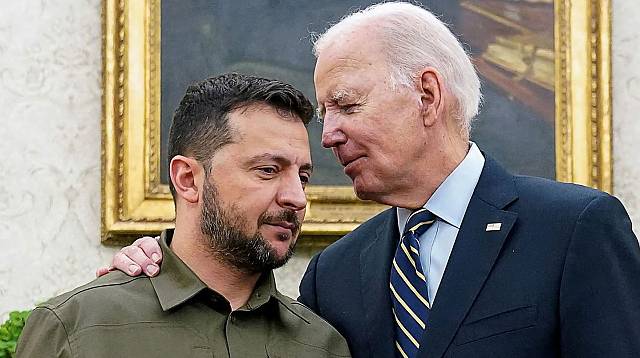
Evaluating US imperial strategies
How Trump and the Democrats try to influence Ukraine. On the 'proxy state' thesis.
Events in Ukraine
Feb 12, 2026
A week ago, some friends organized for me to give a small talk in Cambridge on any topic. I chose to present a synthesis of two reoccurring threads on this substack. On the one hand, splits within the US foreign policy elite. On the other, competing power centers in Ukrainian society.
In short, the talk was about how the two poles of American politics pursue differing strategies of influencing Ukraine. Given that the Europeans along with perfidious Anglion and its satellites are now boldly declaring their brave resistance to Amerikkka, perhaps the old world would do well to learn a thing or two about Washington’s various imperial approaches. If any of my readers are in contact with Mark Carney, link him today’s article so he can learn about the strengths and limits of American policy abroad.
Theory
In terms of the Americans, I am quite enamored with Carl Oglesby’s 1970s heuristic of yankees and cowboys. The yankees are the eastern establishment ivy leaguers and their old money base, the cowboys the brash new capitalists of the southwest.
The Yankees are deeply atlanticist and anglophile, appropriately so given their enmeshment in trans-oceanic New York finance and law. The cowboys represent the westward urge of the frontier, far more interested in plundering resources from weaker peoples than in playing diplomatic games with the old world.
As such, the representatives of the yankees in media, business, and politics ended up strongly criticizing the Vietnam war in the early 70s due to the tensions it was introducing between Washington and its NATO partners in Europe. The cowboys, in contrast, were maniacally dedicated to continuing the war. To give in would be to accept a barrier to the mystical frontier, a barrier to America.
The 60s and early 70s saw something like a civil war between the yankees and cowboys, from the assassination of the Kennedies to Watergate to Vietnam. Where the Kennedies were hated most by the cowboys, Nixon was the bugbear of the yankees. However, in both those cases, it should be noted, the victims did much to earn the ire of their own side, too. In Indira Gandhi’s supposed words, he died because he lost the support of his peers.
Following the aftermath of Watergate, a truce emerged between the two factions. The next few decades would see great unity in the American ruling classes, with the weakness of anti-imperial forces allowing all of the US to revel in overseas plunder and adventures.
And as the latest Epstein files have shown, much of the ideological distance supposedly separating the likes of Steve Bannon and Noam Chomsky is all for show. Even before all that, the likes of the Bush family effected a blood synthesis of southern oil interests and the eastern establishment.
I would also go further and hypothesize a steady cowboyization of the American elite over the past decades. Yankee Atlanticism has lost much of its economic rationale — the industrial base for the exports to Europe that once animated liberal internationalism has eroded. The financialization of the US economy has entrenched the cowboys, as has the growth of speculative tech and a new flock of military industrialists.
This speculative startup capital is at the heart of the cowboy soul, the economic bloc buttressing Trump. Finance: Timothy Mellon. Real estate: Sheldon Adelson. The Silicon Valley military industrial complex: Elon Musk, Peter Thiel, Palmer Luckey. It is these forces that are ascendant in the contemporary American economy.
Along with financialization, the US education system has also suffered from a well-known neglect. As such, one is hard-pressed to find any sort of contemporary Yankee contenders that could rival the likes of JFK. There was an attempt with Obama, but after running the course on that experiment the Democratic party seems to be content with running on autopilot. All initiative is given over to the cowboys.
Anyway, I do think there is something to the Yankee/Cowboy thesis. If anything, it is a useful way of describing two different American strategies towards the world. It is true that polished yankees engage in much of the shady business deals with oligarchic dictatorships the liberal press excoriates the cowboys for doing. But the point is that the yankees still feel the need to hide their involvement in such activities somewhat, because it risks their main approach, one based on prim PR.
The Yankee strategy
And at least when it comes to Ukraine, there certainly are fairly divergent modes of imperial influence exercised by the two fractions of the US elite.
In short, the yankees create long-term institutions. Over the course of decades, the likes of USAID and the Open Society Foundation have been investing major sums of money into Ukraine’s media and NGO sector.
It isn’t just the amount of money that counts. As the Donbass agitator for unification with Russia Pavel Gubarev ruefully noted in his 2016 memoirs, the problem for pro-Russians like himself lay in the higher effectiveness of American spending. Moscow pushed greater sums of money into Ukraine following 1991, but it simply went into the hands of fairly unlikable business-political leaders (called by detractors ‘oligarchs).
The Americans spent less, but did more. USAID funds didn’t just go to openly pro-American groups, but also to NGOs campaigning against animal abuse, smoking, domestic violence. NGOs working on effective treatment for drug addicts. Investigative journalism. And of course, the struggle against corruption.
For young, ambitious, thinking people, it seemed that anything admirable and good just happened to be funded by the west. Yankee NGOs and foreign policy has always tried to prioritize influencing the intellectual middle classes above all else, and with good reason. Historically, this class has always been at the forefront of revolutionary upheaval, whether liberal, communist, or fascist.
Along with NGOs and media, the Yankee strategy has also been to transform or even create new branches of government. This includes court reform and the creation of new, western-monitored anti-corruption organs.
Finally, the Yankees tend to operate through official channels. This is primarily stationed diplomats, but also includes figures higher up the chain of government.
The cowboy strategy
The cowboys focus on individuals and unofficial networks. Spurning the arrogant ivy league mandarins of the state department, they prefer to operate through friendly backchannels they know from business, childhood, or religion. Meanwhile, they suspect Yankee NGOs abroad of participating in coordinated anti-cowboy action in the US. As a result, no more USAID, goodbye Soros.
Of course, this doesn’t exclude working with at least some hallowed American institutions. By this I mean the CIA, and some newer ones like the Special Forces. Like with the use of backchannel contacts, the idea here is to bypass slower traditional forms of diplomacy. Just how effective this is in achieving US goals remains to be seen, but the main aim seems to be acquiring stakes in lucrative assets abroad (something shared by the Yankees as well, but integrated in a broader geopolitical strategy).
At the end of this article, after having gone through the concrete ways these strategies manifest in Ukraine, we’ll evaluate the strengths and weaknesses of both Yankee and Cowboy strategies.
Aside: On the proxy thesis
One important aspect of today’s topic relates to the idea of Ukraine as a proxy of the US. This generally intends to convey the fact that the Ukrainian government is dependent on western economic and military aid, aid which is dependent on Ukraine continuing its status as the bridgehead of covert and overt operations against the Russian Federation.
In that sense, I agree with the proxy thesis. But some people take it too far. They assume that Ukraine’s status as a NATO proxy means that the country’s fate can be unilaterally decided by whoever is in the White House, the cockpit of NATO’s largest member.
But the past year of Trump’s time in office shows that things aren’t so simple. Trump, at least in some manner, naive or otherwise, seems to want to end the war in Ukraine. One can argue about whether this is because he is Putler’s secret agent or if he just wants a Nobel, but the fact remains. However, he has failed to convince the Ukrainian government to go along with this plan by giving up the rest of the Donbass to Russia.
On the one hand, Trump could certainly try harder to put pressure on the Ukrainians. Instead, the Trump administration massively increased intelligence aid to Ukrainian drone strikes on Russian energy infrastructure over the course of 2025, and has now also cut off Starlink access to the Russians.
Nevertheless, this aid seems to largely be a result of Trump’s inability to shift the demands of the Ukrainians. Faced with this, he has tried to enforce greater costs on the Russians as leverage to possibly get them to minimize their demands. I’m sure that Trump would have been much happier if Zelensky had simply agreed to the Russian demands, allowing Trump to claim an easy win and minimize his own involvement with Ukraine, a country he has many bad memories associated with.
In short, it’s clear that while Ukraine acts as a western proxy, this is only true for one fraction of the US elite — the Yankees. It is the Yankee’s atlanticist interests which modern Ukraine fulfills, and these only.
Furthermore, when one says ‘proxy’, it should be prefaced by admitting that the proxies themselves are live creatures.
Yes, copious financing can be named as one of, and sometimes the main factor as to why many figures in Ukraine began cooperating with the Americans. But once they did, it isn’t easy to go back. If Zelensky simply gives in to Russian demands now, he will be decimated by post-war political struggles inside Ukraine, not just as a traitor, but as someone who needlessly prolonged the war and waged it in a senseless, bloody manner.
And if NGOs once funded by USAID (now mainly funded by the EU and various spinoffs of the Open Society Foundation) stopped resisting Trump’s demands, Ukraine would go down what JPMorgan last year called ‘the Georgia scenario’.
Like its counterparts in Tbilisi now, the Ukrainian government would reopen trade ties with Russia. Western military aid would disappear. Fearing the excessive influence of atlanticist NGOs, the government would pass laws banning or restricting ‘foreign funded agents’, as has happened in Georgia. Slowly, the country would creep back to normality. The killing would stop. Naturally, JPMorgan and Ukraine’s security establishment despise talk of the Georgian establishment, and loudly proclaim the need for ‘Israelization’ instead.
And finally, of course, many frontline nationalists would also find things hard in a world after war. Not only would their main source of prestige, power and money disappear, but they might have to answer a number of more than uncomfortable questions. Blocking detachments, the torture and murder of their own mobilized troops. Not to mention a number of other killings.
So yes, Ukraine is a proxy of what could be diffusely called NATO interests. But these interests are most certainly not confined to the white house. Where the white house is under unfriendly forces, European governments, the City of London, and transnational private interests can be trusted to hold the line.
Meanwhile, events in the white house don’t negate the existence of a fairly large community of individuals whose life is entirely tied up with the continuation of Ukraine’s status as an anti-Russian war machine. While this may be a small minority compared with the total Ukrainian population, what matters is that they have money, power, and guns.
Yankee experiments
Canadian ambassador to Ukraine Roman Washchuk said a few years ago that Ukraine is ‘a laboratory for real-world experimentation’. Indeed, I have always been a proponent of the theory that Ukraine is at the avant-garde of global processes, insofar as it is here that NATO tests its most creative new tactics.
Most of the past decade of Ukrainian politics is inexplicable without reference to the US embassy and US-funded NGOs or media groups. I won’t retread the topic of the 2014 euromaidan regime change event (or coup, or revolution, or however you want to call it).
Suffice to say that the man who first called for protest on the euromaidan square on that fateful November 21, 2013 was Mustafa Naiem, journalist at Ukraine’s most influential USAID-funded publication, Ukrainska Pravda. Since 2021, Ukrainska Pravda has been owned by Tomas Fiala, the Czech financier who has worked closely with the Soros family for years. Another major writer and political figure in Ukrainska Pravda is Serhii Leschenko, more on whom soon.
One of the most interesting example of Yankee involvement in Ukraine was the 2016 Russiagate affair. It also reveals the extent to which American involvement in the country is also a manifestation of American political divides.
That’s because of the source of the ‘black lodger’ supposedly showing Trump aide Paul Manafort’s involvement with Russo-Ukrainian political elites. It was sent to the appropriate sources back in May 2016 by none other than Viktor Trepak — a high-ranking figure in the Security Services of Ukraine (SBU), the KGB successor that was systematically co-opted by the CIA starting from the 2000s. Trepak had already made a reputation for himself as strongly pro-American.
Trepak sent this incriminating document, naturally, to the NABU — the National Anti-Corruption Bureau of Ukraine, set up in 2015 on USAID and Open Society Foundation funding and urging. NABU director Artem Sytnyk, constantly defended and promoted by the US embassy despite his own corruption, played a major role in publicizing the content in a press release. And who wrote the article first covering it? Sergey Leshchenko, one of Ukrainska Pravda’s most well-known columnists, today one of Zelensky’s loyal advisors.
It was only later in the year that the NYT picked up on the story. It then tried to use the story to sink Drumpf as a perfidious Russian asset. By 2018, a Ukrainian court accused Leshchenko of unwisely involving Ukraine in American politics, a move that Leschenko decried as president Poroshenko sucking up to Trump.
In any case, all the ingredients of the Yankee approach are here. Ukraine’s ‘independent’ press, its ‘independent’ anti-corruption court apparatus, its ‘independent’ intelligence agencies.
Another excellent example of the Yankee strategy came in 2019. Zelensky had just won the elections on a peace platform, much to the disgust of the NGO community and associated western-funded nationalists.
To make sure that things didn’t get out of hand (ie, fulfilling his election promises), the NGO ecosystem got into battle formation. Dispelling any ideas of Ukraine’s ‘civil society’ as a range of groups representing various points of view, they put out a unified statement on ‘red lines’. If you look at the signatories, you can see all the classic anti-corruption NGOs, infowarriors ‘independent media’ setups, and sundry tentacles of the Open Society Foundation that were all granted exemption from mobilization in 2024.
What were these red lines? Zelensky was essentially warned against implementing the Minsk agreements, the only way to actually end the war in the east and avoid the large-scale conflagration that erupted in 2022. No reintegration of eastern Ukraine with autonomy rights, as per Minsk. The east had to be conquered militarily, with all dissenters to the euro-atlanticist status quo destroyed or run out of the country. And of course, no ‘delaying, sabotaging or rejecting the strategic course for EU and NATO accession’. For whatever reason, Zelensky never violated these red lines.
2020 was also a very important year. In one of my articles, I covered the theory that it was this year which pushed the indecisive Zelensky into the arms of western militarists. The only source of financial aid during the economic crisis engendered by COVID was the IMF, an institution, of course, which is hardly outside of global geopolitics. After all, the IMF broke its own rules by copiously financing Ukraine since 2014, since it is a country at war.
Another important example of Yankee control over Ukraine took place from 2020 to 2021. Serhii Sternenko, the drug dealer-ultrarightwing streetfight who was reborn as an NGO liberal, was being brutally persecuted by Zelensky’s criminal government. In other words, Zelensky’s team, which included rather anti-nationalist figures like Oleg Tatarov, were finally prosecuting Sternenko for the murder of an unarmed man he had committed on Facebook livestream in 2018.
The ‘freedom for Sternenko’ movement led to a wide mobilization of NGO liberals and their friends in the nationalist communist. The most powerful nationalist movement, Azov, however, condemned Sternenko as a drug dealer involved in the brothel business who had sold out to the LGBT NGO libtards.
But that didn’t matter, given that Sternenko had the full force of the NGO industrial complex behind him. Washington heavy hitters like US citizen and former minister of health Olana Suprun vocally supported Sternenko. Sternenko’s goons trashed Zelensky’s presidential administration in 2021.
Sternenko himself called Zelensky a ‘dictator’ who would ‘meet a worse fate than Yanukovych’. Given that president Yanukovych fled the country in 2014 after constant threats to his life, one can understand what was meant by that.
So the charges were dropped (he was only really being charged with a separate torture and extortion case anyway), and Sternenko walked free in May. Today he is a prominent official advisor to the minister of defense, despite being a lifelong draftdodger. It does well to have the Yankees behind you.
And Zelensky’s ability to enforce his will on the most clean-cut murder case was shattered. The president was shown once again that there is no need to try and touch Yankee assets. He learned the same lesson during his failed 2025 attempt to shut down the NABU’s independence.
Then in late 2021, you had an entirely media-based Yankee operation. Bellingcat, the media branch of MI6 which has appeared in the Epstein files in a quite interesting manner, released a thunderous new investigation. It purported to show that Zelensky and his devious chief of staff Yermak had pulled the plug on a daring operation to deceive and capture Russian fighters from the Wagner PMC. Yermak had apparently told his Russian counterparts about the operation back in 2020 in order to safeguard ongoing peace talks. How despicable!
The never-ending ‘Wagnergate’ ensued. As even the New Yorker noted, anti-Zelensky, pro-western nationalists used it to weaken the president by accusing him of treason. Head of military intelligence Vasyl Burba, sacked by Zelensky in 2020, called the president a traitor. Military officers in western Ukraine held a press conference dedicated to the cruel stab in the back, calling for an independent commission into the ‘betrayal’. It almost seemed like a military coup was incoming.
War in 2022 saved Zelensky from that fate, if it was ever really imminent. But what matters here, again, is the way that ‘independent media’ on atlanticist payrolls function to keep all Ukrainian governments on the defense, constantly trying to prove their true nationalist credentials. And hence, peace is always impossible.
Finally, official channels. We’ve been talking about NGOs, media, and institutions like the NABU. To make sure that successive Ukrainian presidents didn’t do anything rash vis a vis Yankee proxies in Ukraine, ambassadors like Marie Yovanovitch were there to help. Ukraine’s prosecutor general Yuri Lutsenko said in 2019 that Yovanovich explicitly told him that there was to be no unwise moves against the heads of the NABU and other yankee-friendly individuals like the SBU’s Trepak.
And naturally, every IMF loan contains clauses not to do anything rash about ‘the anti-corruption infrastructure’.
Those who go against this don’t end well. Zelensky’s chief of staff Andriy Yermak, though a fanatic supporter of forever-war, deeply frustrated successive US diplomats. That’s because he had the gall to get rid of figures chosen by the embassy.
In 2024, he was rude enough to remove of Oleksandr Kubrakov, the minister of infrastructure beloved by the Americans and the NGO community. In response, US ambassador Bridget Brink wrote to social media about how sad she was to see Kubrakov go, and western media wrote even more pieces on Yermak’s tyranny.
And so, it was no surprise to see Yermak resign his post in November 2025, endlessly pursued by the NABU and atlanticist NGOs and media groups. Following Yermak’s absence, Yankee assets like Sternenko have risen, and their beloved Mikhailo Fedorov has become defense minister.
Cowboy adventures
Now let’s move onto the even more byzantine world of cowboy tactics in Ukraine.
First, the failures. Trump boasts far fewer assets in Ukraine compared to his Democrat rivals.
We just had a look at the charmed life of the democrat-aligned Sternenko. Take a look at Ukrainian political figures who threw in their chances with Trump. Oleksandr Dubinsky, an MP in Zelensky’s party, has been imprisoned since 2023 for his role in publicizing Hunter and Joe Biden’s dark deeds in Ukraine. This was judged as ‘damaging Ukraine’s relations with its main partner’ (the same accusation a court made vis a vis the pro-yankee forces that initiated Russiagate, though that ended up going nowhere).
Or veteran politician and former prime minister Yuliya Tymoshenko. Known for her attempts to present herself as a mediator for peace with Trump in 2025, she excoriated the western-funded anti-corruption organs in July 2025. So in 2026, the anti-corruption organs have accused her of corruption on rather flimsy charges, threatening up to 10 years in prison.
It doesn’t pay well to be Trump’s friend in Ukraine. Dubinsky is still in prison, despite his daily performances proving just how much he loves daddy Trump. High-level figures in Trump world sometimes even retweet him. But to no avail.
Ron Lauder is probably the perfect example of cowboy backchannel diplomacy in Ukraine and abroad. Lauder, Trump’s college friend, gave him the idea to annex Greenland in 2019. Lauder’s son-in-law is set to become the chair of the fed. A very important fellow, in other words.
Lauder has had quite a charmed life, starting out as head of the international department of Estee and Lauder, then becoming an official in the DoD on relations with NATo and Reagan’s ambassador to Austria in the 80s.
He continues his role as international man of mystery, whether through his late 90s talks mediating Syria and Israel, talks with Syria’s Ahmed Al-Sharaa in 2025, or when Trump gave him control of a Ukrainian lithium reserve that same year. I’ll note that Lauder was quite unsuccessful in the 90s talks, and it is unclear to what extent he has succeeded regarding Ukraine and Sharaa/Jolani.
But Lauder’s Ukraine connections go way back, making it no surprise why Trump chose him to manage his new east European assets. Back in the 90s, it was Lauder who provided the necessary capital for a 1+1, a fledgling Ukrainian media group. Within a few years, the ever more popular comic Volodymyr Zelensky began working with 1+1.
By 2015, the 1+1 hit television show ‘Servant of the People’ featured Zelensky playing a schoolteacher who became president. The show’s slogan: ‘The story of the man who will become president’. And become president he did.
Lauder also has a number of important ties with the Ukrainian elite. Since 2007, the vocal Zionist has been head of the World Jewish Congress (WJC). On the presidium is Aleksandr Rodnyansky, the Ukro-Russian producer who made 1+1, the most important figure throughout Zelensky’s career. Rodnyansky was also the mediator of the March 2022 Russia-Ukraine talks.
The vice president of the WJC is Boris Lozhkin, another heavy hitter of Ukraine’s oligarchy. He was chief of staff for president Poroshenko (2014-19), with the role of the president’s main intermediary with the business elite.
Lozhkin is also president of the Jewish Confederation of Ukraine (JCU), founded in 1999. One of the members of the JCU’s supervisory board is Mikhailo Tsukerman, the man who fled to Israel in November 2025 after the NABU released information about high-level corruption in Zelensky’s inner circle.
Along with Tsukerman, Timur Myndich, the supposed organizer of the embezzlement ring, also fled to the Promised Land. Myndich is one of Zelensky’s oldest friends. He was the one who introduced Zelensky to Igor Kolomoisky back in 2008. It was Kolomoisky who bought 1+1 from Lauder for over $400 million USD. And it was Kolomoisky who brought Zelensky to power in 2019.
Kolomoisky, one of Ukraine’s most powerful oligarchs, got very tired with the Yankees after 2015, despite helping them bring the euromaidan to power in 2014 and suppress dissent in the east. He was frustrated because the IMF forced Ukraine to nationalize his shadow financial empire PrivatBank. The NABU and other anti-corruption organs were constantly trying to take down the mercurial Kolomoisky. Ukraine’s oligarchs have their own independent interests, and hence the main task of the west is ‘de-oligarchization’, with their replacement by transnational western corporations.
And so Kolomoisky began calling for detente with Russia and blaming the US for pulling Ukraine into an endless war. He supported Zelensky’s peace platform. And he finally returned to Ukraine from Israel right after Zelensky’s victory, no longer having to fear extradition to the US.
Kolomoisky is also a long-time financial supporter of the Jewish network Chabad. A group that Trump is also quite close to, with his son-in-law Jared Kushner a prominent member. Let’s now move onto a story where Trump’s team tried to leverage these connections.
Naturally, figures loyal to Kolomoisky began trying to help Trump in his task to prove that the 2016 Russiagate was instigated by the Democratic party’s demonic Ukrainian creatures. In 2019-20, MP Andrey Derkach released a number of tape recordings showing the unsavoury activities of the Yankees in Ukraine.
In an October 2019 interview for the Ukrainian state media platform Interfax, Derkach said that his leaks were ‘the key for salvaging Ukraine-US relations’. He drew attention to how the recordings highlighted the corruption of the Biden family, in cohorts with the NABU.
It was clear that Zelensky’s administration was allowing and encouraging the leaks to get Trump’s support. Zelensky also famously promised to help Trump get dirt on the democrats in the 2019 phone call whose release led to Democrat attempts to impeach the president.
MP Oleksandr Dubinsky was one of the loudest supporters of the Derkach tapes. But now Dubinsky and Kolmoisky are in jail, and Derkach is in Russia. There were rumours in 2025 that Kolomoisky was trying to reach out to Trump for help through their mutual associate Boris Epshteyn, but to no avail.
And now, back to everyone’s beloved Chabad. In the heady days of 2019, Trump’s wise consigliere Rudy Giulani made a bizarre secret trip to Ukraine. The details leaked to the Yankee press, so we have an idea of what went down (or was meant to). Giulani was heading to the village of Anatevka, an area set up by Chabad in 2015 as a refuge for (Jewish) internally displaced people. It had the name of the village in Fiddler on the Roof.
Giulani’s trip was cancelled due to the negative press coverage, but he still shared a Cuban cigar with some of Ukraine’s Chabad head honchos in Paris. He was also made the honorary mayor of Anatevka.
Besides all the fun he was having, the idea, as usual, was to gain access to figures in the Ukrainian politico-economic elite opposed to the democrats, ideally gaining dirt on the Biden family in the process.
But Trump vacated the white house, and Zelensky became definitively secured by Yankee interests over the course of 2019 to 2020. He ended up persecuting and sanctioning figures like Kolomoisky and other anti-democrat political parties. In the lead up to his sanctioning by the US in early 2021, American media published a number of pieces about Kolomoisky’s corruption in the USA, which, of course, operated primarily through a number of Chabad organizations and individuals.
In short, Trump’s byzantine backchannel diplomacy was not to be.
The final possible avenues for cowboy influence in Ukraine are various intelligence agencies and their assets. The CIA has long entertained very close ties with Ukraine’s military intelligence chief (2020-26) Kyryllo Budanov, who is now Zelensky’s chief of staff. Budanov has been quite vocal about his support for Trump and even the idea of a ceasefire.
But just how genuine is this, and how much can he translated this into reality? Having been appointed Zelensky’s chief of staff, he has lost the grand assets available to him until 2025 as head of military intelligence. Now he’s stuck in endless negotiations with Russia, while the pro-war, Zelensky-controlled SBU (security services of Ukraine) tries to assassinate key figures in Russia’s negotiation team in an obvious attempt to disrupt Budanov’s negotiation attempts. Budanov and the SBU have long been at loggerheads.
You also have David Arakhamia, head of Zelensky’s parliamentary fraction. He has long been rumoured to have US citizenship, a product of his time in the 2000s as a tech mogul in the states. He was also arrested by the FBI due to his involvement with the world’s largest cyber-criminal network. And then immediately released, leading to the leader of said cyber-criminal network (who currently works for Ukrainian military intelligence) to make the the obvious conclusion that Arakhamia has been an FBI asset ever since.
Arakhamia is well positioned for the cowboys. Arakhamia often says things that seem to paint him as a supporter of peace and Trump, like his famous 2023 statement that Boris Johnson disrupted negotiations and pushed Ukraine into endless war in March 2022.
But whatever Arakhamia and Budanov may want, so far they seem outmatched by the vast Yankee infrastructure set up over the past few decades. And while they may be happy to score political points as peaceniks among the dissatisfied Ukrainian population, what the ordinary cattle want has never mattered that much anyway. Arakhamia and Budanov are powerless against the inertia of war and its supporters.
And a final cowboy adventurer. Erik Prince spent much of 2019 attempting to buy the Ukrainian aeronautics plant Motor Sich. He also entertained plans of constructing some sort of vast private army and military training centre on Ukrainian territory. But as usual with Trump’s zany projects, it came to nothing. China was blocked from purchasing Motor Sich, the crucial factory slipped further into decline, and nothing more.
One victory after another.
Evaluating the Yankee strategy
When it comes to the Yankees, it is hard not to be impressed at the breadth of their ambition. Instead of merely focusing on co-opting and replacing the ruling elite of targeted countries, an entire eco-system of counter-elites has been created. They outlive each government and don’t have to worry about winning elections. The party representing the pro-western NGO class, Holos, struggles to get even 5% in elections.
In most countries, to paraphrase the saying about Arabs, one can rent elites but not buy them. This was fairly clear from the complex relationship between president Petro Poroshenko (2014-19) and the US. Despite being an avowedly eurocentric warrior against Russia, Poroshenko was also an experienced oligarch with his own interests. As such, the Americans quickly realized that he wasn’t going to always implement their demands if it damaged his own interests.
An example is his repeated slowdown of the selection process for new heads of the NABU, along with other conflicts between him and the anti-corruption infrastructure.
The NGOs and media publications created largely ex nihilo by the Yankees, unlike traditional politicians and oligarchs, are entirely dependent on their sponsors. Lacking, say, industrial assets that could be damaged by war, they are happy to aggressively push for whatever aggressively anti-Russian agenda their sponsors demand. Hence, while Ukraine’s oligarchs keep on leaning towards detente with Russia, the NGOs are always there to curtail such drift.
However, it isn’t so simple as simply implementing orders. The ‘civil society+’ ecosystem created by the Yankees over the past few decades has its own momentum, its own inertia, its own lives and careers to worry about.
As a result, even if, say, Joe Biden or Barak Obama wanted Ukraine to come to a detente with Russia, it probably wouldn’t be as simple as phoning the NGO leaders and telling them to do so. Back in late 2021 and early 2022, the Ukrainian government and the NGO community was hysterically fearful that the US would ‘force us to implement the Minsk agreements’, thereby ending the war by reintegrating the Donbass into Ukraine with autonomy rights.
I’m still not quite sure to what extent that was a figment of their over-active imagination, but I do believe that to do so, the only option for Washington would simply be to abandon its Ukrainian allies entirely — the Kabul 2020 scenario. Not something that Washington likes to do too often, for understandable PR reasons.
The blob, in other words, is a viscous mass that can’t simply be told to stop flowing. Nor is it easy to control the spores it has seeded across the world.
There are other problems with Yankee strategy as well. The civil society ecosystem I am speaking of is limited to a small group of urban representatives of the middle class, particularly so-called ‘creatives’. As I mentioned, parties representing this vector struggle to achieve 5% in elections.
Their problems only seem to be getting worse. The stirring slogans and excellent PR of this crowd were quite dazzling when they first reached the Ukrainian populace in the 2010s. But it still didn’t let them win elections — the euromaidan only won out following the bizarre sniper killings of February 18-20.
And by 2019, the nationalism and neoliberal reforms pushed by the NGO establishment led to the 73% of the population voting for Zelensky, who presented himself as the antipode to the technocratic liberals.
In wartime, the NGO class has achieved its goals of militarizing society, aggressive cultural Ukrainization, eradicating all dissidents, and shipping off the male population to the front. And all the top NGOs have had their employees exempted from mobilization by Zelensky’s cabinet.
But some day peace will come (I suppose), and those who supported this bloodbath will be quite unpopular indeed. Top representatives of the NGO world worry and talk about this quite often, hence their enthusiasm for continuing the war indefinitely.
An example is Georgia. Here, decades of hot/cold war with Russia, harsh neoliberal reforms, and unfulfilled promises of membership in the EU have led to widespread disappointment in the cause of euro-atlantic integration. Some old mainstays of this crowd have even defected to the cause of supporting Russia. In general, the population is simply very tired of it all, particularly the endless, hysterical, and pointless protests in the capital by the privileged diehards of the NGO community. So naturally, the party promising peace, stability, and no more NGOs sweeps elections.
Endless war is imperative for the Yankee clients. It allows them to stave off the inevitable.
Evaluating the cowboy strategy
Judging by the results, it is hard to come to the conclusion that the cowboy strategy is more effective than the yankee one. At most, Trump insiders like Lauder can boast theoretical control over some Ukrainian mineral resources. The trouble is, however, that not only will it be rather difficult to extract these minerals in wartime, but it is quite likely that the actual size of Ukrainie’s mineral wealth has been significantly exaggerated by the Ukrainians in the attempt to get Trump’s attention.
And as should be fairly clear by now, figures like Lauder, Myndich or Kolomoisky are not particularly popular in Ukraine. Of course, Kolomoisky does come out with lots of zingers, and there is a growing category of tiktoks and Instagram reels glorifying Kolomoisky as a straight-talking hustler, with the commenters semi-ironically declaring they want him as president.
Perhaps the future will see some new Kolomoisky-funded populist projects. But that was what Zelensky was originally, and now he has turned into something else entirely, even sending Kolomoisky himself to prison in 2023, from where he seems unlikely to return any time soon. The problem is that all these populist individuals find it very difficult to compete with the vast network of institutions and organizations set up by the Yankees over the past few decades.
At most, the cowboy approach can boast its immortality. What I mean by that is that while western-funded NGOs can certainly disappear from a society, as occurred in Russia, China or Belarus, it is rather more difficult to get rid of the capitalists. Trump will always have people in the Ukrainian elite eager to talk with him. The NGOs, in contrast, are constantly fighting against popular distrust, with their backs against the wall.
Let the best proxies win!
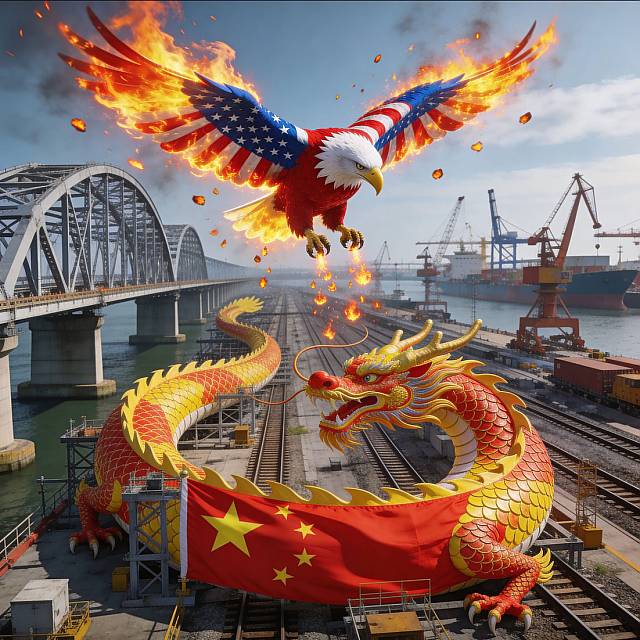
The Chinese Long Game vs. the American Arsonist
Does Patience Work Against an Enemy Who Burns Everything You Build?
BettBeat Media
Feb 13, 2026
I wrote a few days ago that BRICS had learned to kneel. I wrote that the Global South deliberates while gangsters batter down the door. I called for defiance—sanctions on the genocide state, severance of the arteries feeding the imperial machine, action instead of communiqués.
What if I was wrong?
Not about the gangsters. They are real. They kidnap presidents and bomb children and call it civilization. They are the Epstein class, the Davos predators, the men who rape and murder but never face justice. I was not wrong about them.
But I may have been wrong about what I mistook for inertia. What I called kneeling may have been patience. What looked like submission may be strategy—a long game I was too impatient, too Western in my thinking, to recognize.
So if I was wrong, does that change anything? Does an alternative interpretation of what China does (or does not do) in the face of Empire bring us any hope?
Honestly? I don't know. And that terrifies me.
The Long Game
China does not fight the way America fights.
America bombs. America sanctions. America coups. America installs and deposes and invades and occupies. It has eight hundred military bases circling the globe. It spends more on weapons than the next ten nations combined. It speaks the language of shock and awe, of overwhelming force, of violence so spectacular it becomes its own justification. It is the nation of guns, slavery, genocide and white supremacy.
China builds.
It builds ports in Pakistan and railways in Kenya and highways across Central Asia. It builds chip factories and solar panels and electric vehicles. It builds alternative payment systems and development banks and trade networks that route around American control. While the Empire bombs, China pours concrete. While the Empire sanctions, China signs contracts. While the Empire makes enemies, China makes customers.
This is the long game. Patient. Incremental. Invisible until suddenly it is everywhere, until one day the world wakes up and discovers that the roads all lead to Beijing, that the loans all come from Chinese banks, that the future was built while the West was busy destroying the present.
The theory is elegant: let the Empire exhaust itself. Let it bleed treasure and credibility in endless wars. Let it sanction itself into isolation while China trades with everyone. Let the American century end not with a bang but with a balance sheet, a slow accounting of debts unpaid and infrastructure unbuilt and allies alienated and opportunities squandered.
Do not confront the Empire. Outlast it.
I have mocked this patience. I have called it cowardice dressed in strategic language. I have demanded that BRICS stand and fight while there is still something left to fight for.
But there is a question I did not ask, a question that haunts me now:
What if the long game is the only game that does not end in annihilation?
The Arsonist’s Veto
And yet.
The theory assumes a rational opponent. It assumes an empire that, however brutal, operates according to some internal logic—that seeks to win, that calculates costs and benefits, that can be outmaneuvered through superior positioning.
But what if the opponent is not rational? What if the opponent is an arsonist?
Consider what America has done in the last year alone.
It has kidnapped a sitting president, shredding every norm of sovereignty and international law, daring the world to respond.
It has funded and armed a genocide, vetoing every attempt at ceasefire, providing the bombs that incinerate children in their tents.
It has threatened to annex the territory of a NATO ally—Greenland, a possession of Denmark, absorbed into the Empire’s ambitions as casually as a corporation acquiring a subsidiary.
It has sanctioned itself into confrontation with half the world, weaponizing the dollar until the dollar’s victims began building alternatives, then threatening war against those alternatives.
It has bombed Iran, positioned carriers, beaten drums, prepared the propaganda for another catastrophic war in a region already drowning in American-made catastrophe.
This is not the behavior of a rational actor playing to win. This is the behavior of a system that has decided: if we cannot dominate, no one will. If we cannot rule the future, there will be no future worth ruling.
The arsonist does not care about the building. The arsonist only cares that it burns.
China builds a port. America destabilizes the country around it. China extends a loan. America sanctions the recipient into default. China cultivates an ally. America coups the government and installs a puppet. Over and over, decade after decade, the pattern repeats: whatever China builds, America burns.
Does the long game work against an opponent who carries matches?
The Graveyard of Patience
The history of American intervention is a history of patient construction reduced to rubble.
Libya had the highest standard of living in Africa. Gaddafi was building pan-African institutions, proposing a gold-backed currency, demonstrating that a nation could develop outside the Washington consensus. Today Libya has open-air slave markets. The construction of decades erased in months of NATO bombs.
Iraq was a functioning state, brutal but stable, with infrastructure and institutions and a middle class. America turned it into a charnel house, a factory of refugees and corpses, a wound that still bleeds twenty years later.
Syria tried to chart an independent course. For that crime, it was sentenced to a decade of proxy war, its cities reduced to rubble, its people scattered across continents.
Venezuela built social programs that lifted millions from poverty. For that crime, it was sanctioned into starvation, its president now sits in an American cell, its sovereignty revealed as a fiction maintained only at the Empire’s pleasure.
In each case, the patient work of years was destroyed in weeks. In each case, the lesson was the same: you can build, but we can burn faster than you build. You can develop, but we can destabilize faster than you develop. You can rise, but we will always be there to push you back down.
This is not competition. This is not even imperialism in the classical sense. This is nihilism with aircraft carriers—the pure exercise of destruction for destruction’s sake, the demonstration that power means the ability to reduce alternatives to ash.
How do you play the long game against an opponent who has decided that if they cannot win, the game itself must end?
The Question I Cannot Answer
So I ask myself the question that keeps me awake:
Was I wrong to demand confrontation? Or was I wrong to doubt it?
The long game assumes the game continues. It assumes that what is built today will still stand tomorrow, that patient accumulation will eventually outweigh violent destruction, that the tortoise really does beat the hare.
But the hare has nuclear weapons. The hare has eight hundred bases. The hare rapes children on private islands while planning the next genocide with friends who will never face justice. The hare has demonstrated, repeatedly and proudly, that it will burn any board on which it is losing.
China builds the Belt and Road. America funds separatists in Xinjiang and protests in Hong Kong and military exercises in Taiwan. Every thread China weaves, America tries to cut.
China develops chip manufacturing. America sanctions every company that supplies it, pressures every ally to join the blockade, wages economic war to preserve technological supremacy.
China cultivates relationships across the Global South. America coups any government that tilts too far from Washington, sanctions any economy that trades too freely with Beijing, bombs any infrastructure that might serve Chinese interests.
The long game requires that something survive to the end. But the arsonist’s entire strategy is ensuring nothing survives.
The Horror I Cannot Name
And here is the question that truly haunts me, the question I almost cannot bring myself to ask:
Is the Empire forcing China to become what it claims to oppose?
If patience is met with destruction, what remains but force? If every port built is bombed, every ally couped, every institution undermined, what choice is left but to defend with weapons what cannot be defended with contracts?
If the long game cannot work—if the arsonist burns faster than the builder builds—then the builder must either accept defeat or become something other than a builder.
China’s military budget grows. Its navy expands. Its missiles multiply. Its rhetoric, once cautious to the point of opacity, grows sharper. Is this the natural development of a rising power? Or is it something darker—the transformation of a civilization that wanted to build into one that has learned it must also destroy?
The American empire may be producing the very threat it claims to oppose. By demonstrating that peaceful rise is impossible, that patient development will always be met with violent suppression, that the only language Washington understands is the language of force—by demonstrating all this, repeatedly, proudly, catastrophically—the Empire may be teaching China that the long game is a fool’s game. That construction without the capacity for destruction is merely a list of targets. That the only way to survive an arsonist is to become fireproof—or to strike first.
This is the logic of arms races. This is the logic that turned Europe into a slaughterhouse in 1914. This is the logic that brought the world to the brink in 1962.
And it is the logic that American policy is imposing on China, day by day, sanction by sanction, provocation by provocation.
The Trap
I see the trap now, and I do not see the way out.
If China remains patient, America destroys what it builds. The long game fails because the board keeps burning.
If China becomes militant, America gets the enemy it needs to justify its own militarism. The Cold War returns, and with it the logic of nuclear brinkmanship, of proxy wars across every continent, of an arms race that devours resources desperately needed for a planet in ecological collapse.
If China confronts, it risks global annihilation. If China waits, it watches its work reduced to rubble.
The Empire has constructed a choice between submission and apocalypse. And it has done so deliberately, because submission and apocalypse are the only outcomes that preserve American dominance. A world where China rises peacefully, where alternatives flourish, where the Global South develops outside the Washington consensus—that world is intolerable to the imperial Epstein class. They would rather rule over ruins than share a thriving planet.
Psychopaths do not worry the same worries as human beings.
This is the mentality of the abuser. If I cannot have you, no one will. If I cannot dominate, no one will prosper. If I cannot win, the game itself must be destroyed.
If the pedo cannot freely take children, he will burn the world.
And we are all trapped in this relationship, all eight billion of us, hostages to a ruling class that would rather end the world than relinquish control of it.
The Genius or the Catastrophe
But perhaps—perhaps—I am still wrong.
Perhaps the long game accounts for the arsonist. Perhaps patience is not naïveté but the deepest form of strategy.
Consider: every act of American destruction exposes the Empire more completely. Every coup, every bombing, every kidnapped president demonstrates to the world what Washington truly is. The mask does not slip—it is torn off and burned in the public square.
Libya showed that cooperation with the West means death. Gaddafi gave up his weapons, opened his markets, made his peace with the Empire. They sodomized him with a bayonet and laughed about it on television. Every leader in the Global South watched. Every leader learned.
Iraq showed that American wars create only chaos. Twenty years later, the region still bleeds. The refugees still flow. The instability still spreads. No one can look at Iraq and believe that American intervention brings democracy or prosperity or peace.
Gaza shows that Western (un)civilization is a lie. The nations that lecture the world about human rights fund extermination. The nations that built Holocaust museums provide bombs for genocide. A generation has watched this happen in real time, on their phones, undeniable and unforgettable. The moral authority of the West has not eroded—it has evaporated.
Every fire the arsonist sets illuminates his face. Every building he burns becomes evidence against him. The Empire is not winning through destruction. It is destroying itself, immolating its own credibility, proving with every action that it cannot be trusted, cannot be partnered with, cannot be allowed to lead.
Perhaps the long game is not about outbuilding the arsonist. Perhaps it is about outlasting him—letting him burn through his credibility, his alliances, his resources, his legitimacy, until the world sees clearly what was always true: that the Empire offers nothing but destruction, that its promises are lies, that its partnerships are death sentences.
Perhaps the genius of Chinese strategy is not building faster than America can destroy, but building the evidence of what America truly is.
But the Dead Cannot Wait
And still.
And still the children die in Gaza. Still the bombs fall. Still the Syrians suffer. Still Maduro rots in his cell. Still the Empire destroys, and those caught in the destruction cannot wait for strategic patience to mature into strategic victory.
The long game offers no comfort to the dead. It offers no justice to the victims. It offers only this: the possibility, uncertain and distant, that their deaths might mean something. That the world emerging from this darkness might be worth the price paid to reach it.
This is not enough. It will never be enough. No strategic calculation can redeem the murder of children. No geopolitical victory can resurrect the dead.
But it may be all that is available. It may be the only alternative to a confrontation that ends in nuclear fire. It may be the terrible, unforgivable, necessary calculus of a species that has built the weapons of its own extinction and placed them in the hands of those least fit to wield them.
The Question
So I return to where I began.
Was I wrong to demand confrontation? Perhaps. If confrontation means apocalypse, then yes—I was wrong.
Was I wrong to doubt the long game? Perhaps. If patience means survival, if outlasting means victory, if the arsonist eventually runs out of fuel—then yes, I was wrong to doubt.
But here is what I cannot reconcile:
The long game requires that China remain what it is—a builder, a trader, a nation that wins through construction rather than destruction. But the Empire’s strategy is designed to make building impossible. Every port becomes a target. Every ally becomes a coup waiting to happen. Every investment becomes a vulnerability.
And so China builds military bases in the South China Sea. And so China expands its nuclear arsenal. And so China develops hypersonic missiles and aircraft carriers and the whole apparatus of destruction that it once seemed to reject.
Is this wisdom? Is this the necessary fireproofing of a builder forced to defend against arsonists?
Or is this the Empire’s true victory—not defeating China, but transforming it? Forcing the patient builder to become another militant power, another node in the endless cycle of arms races and proxy wars and mutually assured destruction?
Someone once observed that Hitler's greatest success was not the Holocaust itself, but turning his victims into the most vehement followers of his way. Israel, born from genocide, now commits genocide. The abused becomes the abuser. The lesson learned is not "never again" but "never again to us—and we will do whatever it takes to ensure that, including becoming what destroyed us.
The Empire cannot tolerate a world where alternatives succeed peacefully. So it ensures that peace is impossible. It forces its opponents to choose between submission and militarization. And either way, the Empire wins: either it maintains dominance, or it ensures that whatever replaces it is built in its own violent image.
What I Know and What I Do Not
I know the Empire is dying. I know its death will not be gentle.
I know China plays a long game. I know that game has yielded extraordinary results—a nation of peasants transformed into the world’s largest economy in a single lifetime, without the invasions and colonizations that marked every other nation's rise to power.
I know the Empire cannot tolerate this success. I know it will do anything—anything—to prevent a world where alternatives flourish.
I do not know if patience can survive the arsonist. I do not know if the long game works when the other player burns the board. I do not know if China can remain what it is—a builder—or if the Empire will succeed in forcing it to become something else.
I do not know if I was wrong to demand confrontation. I do not know if I was wrong to doubt patience.
I know only that we are trapped between two forms of catastrophe: the catastrophe of submission, and the catastrophe of war. The Empire has made certain that these are the only options. It has burned every other path.
Except one.
Revolution.
- Karim