Explained in 17 minutes: the Ukraine war
Mehr als eineinhalb Millionen Ukrainer und Russen tot, mehrere Millionen verwundet: der Ukraine-Krieg hat in den letzten vier Jahren unermessliches Leid verursacht. Die Verantwortung für diesen menschengemachten Wahnsinn wird bei uns im Westen gerne in Moskau gesucht. Nach Meinung eines amerikanischen Insiders, der es wissen sollte, sitzen die Strippenzieher dieses noch immer andauernden Massenmordes freilich in Washington und in Brüssel. Eine Rekapitulation in 17 Minuten.
In einem Post zum 12. Jahrestag des Beginns der ATO, der sogenannten “Anti-Terror Operation”, macht auch der kroatische Wirtschafts- und Politanalyst Alex Krainer die treibenden Kräfte hinter dem Blutvergießen in der Ukraine nicht in Moskau, sondern im Westen aus.

The Maidan coup and the breakup of Ukraine
Today, 15 April 2026, marks the 12-year anniversary from the start of Ukraine’s anti-terrorism operation (ATO), which set off a cascade of events leading to a civil war in Ukraine and which made the ultimate clash between Russia and the U.S./NATO all but inevitable. The ATO was a critical part of Western powers’ attempt to take full control of Ukraine, but at the same time, its nature and intensity was deliberately obscured in the Western media.
Violent overthrow of the democratically elected government of Alexander Yanukovich took place in February 2014 and it provoked strong resistance in the southern and eastern regions of Ukraine where the majority of people understood what took place in Kiev. These were the most populous regions of Ukraine which overwhelmingly supported President Yanukovych. In the Donbas, Yanukovych had received over 90% of the vote in the 2010 elections and the people there did not accept his violent overthrow.
In the immediate aftermath of the coup, Russia moved to secure the Crimean peninsula. On 27 February 2014, Russian troops that were stationed in Crimea secured all of the peninsula’s strategic points to prevent a forcible takeover by the forces of Kiev junta. On 16 March, Crimea held a referendum to a very large turnout (83.1%) and 96.77% of the votes (1.23 million) were in favor of the peninsula re-joining Russia. Two days later, on 18 March, the Kremlin officially annexed Crimea as a constituent part of the Russian Federation.
Meanwhile, in other parts of the east and the south of Ukraine demonstrations against the new regime multiplied, disabling Kiev’s attempts to take full control the country. Kiev’s Western sponsors exerted pressure on the new government to crack down on these protests and consolidate control of the whole country. As a result, in early March 2014 Kiev began sending convoys of troops armed with helicopters, artillery and tanks toward the mutinous regions.
However, the people of the eastern regions of Donetsk and Lugansk organized to block their advance. Because the ordinary Ukrainian soldiers were reluctant to unleash violence on their fellow citizens, these acts of civilian resistance proved effective and the regime was in danger of losing control of the country’s south and east regions. On 13 March, the Junta moved quickly to form a more aggressive force, a 60,000-strong National Guard. Led by the new security chief Andriy Paruby, the National Guard would play a similar role in Ukraine as Ernst Roehm’s Storm Troopers played in Germany during the 1930s: it would be to carry through an onslaught against any elements disloyal to the regime.
At the same time, the Interior Minister Arsen Avakov took up the task of spiking up the rest of Ukraine’s armed forces by seeding almost all of their regular units with at least two or three far right radicals to overcome the troops’ scruples about violence. These men were assigned to accompany the regular army units, confront the protesters and enforce the Junta’s commands.
As John Pilger reported in The Guardian at the time, Ukraine was turned into a CIA theme park, run personally by the CIA director John Brennan in Kiev, with dozens of “special units” from the CIA and FBI setting up a “security structure” overseeing savage attacks on those who opposed the February Coup.
Kiev’s ATO triggers a civil war in Ukraine
In this way, the stage was set for a civil war in Ukraine. What’s important to recognize, however, is that the pressure to consolidate Junta’s control over the Donbass originated with the international banking cartel, the IMF acting as their conduit.
Immediately after the coup, US Treasury Secretary Jacob Lew indicated that Ukraine’s discussions with the IMF were crucial. Lew held discussions with the junta’s leader Arseniy Yatsenyuk and assured him that his government could count on a broad international assistance coordinated by the IMF. Lew then instructed the IMF chief Christine Lagarde that Ukraine needed to quickly begin implementing the requisite “structural reforms.” Two weeks into Kiev’s ATO, on Wednesday, 30 April 2014, the IMF signed off on a $17 billion aid package for Ukraine.
IMF money, with strings attached
This was the very same IMF that only six months prior could come up with only $4 billion in aid, subject to extremely harsh conditions. But for the new regime, $17 billion was doable, only with different strings attached this time. One day after approving the new aid package, the Fund’s staff report pointed to the obvious problem:
“… unfolding developments in the east and tense relations with Russia could severely disrupt bilateral trade and depress investment confidence for a considerable period of time, thus worsening the economic outlook. … Should the central government lose effective control over the east, the program will have to be re-designed. ”
A CNBC article titled, “IMF warns Ukraine on bailout if it loses East” noted that Kiev’s actions were “politically driven by key IMF shareholders to support the Yatsenyuk ‘kamikaze’ administration in its reform efforts.”
How important was IMF’s role? On 26 November 2014, Prime Minister Yatsenyuk said as follows:
“Our cabinet has resumed the program of activity and cooperation with the International Monetary Fund, the European Bank for Reconstruction and Development and other banks. Today international investors are not ready to go to the country but international banks are ready to help us. … We would not have survived without the international assistance.”
However, to earn that vital assistance from western banking cartel, Kiev would have to take full control of the defiant eastern regions which accounted for nearly 80% of the nation’s GDP.
It’s (as always) the collateral, stupid!
Why, we might ask, were the banking interests so keen that their Kiev junta retain control of the Donbas? It all had much less to do with its freedom and democracy and more with its large coal industry, ferrous-metallurgy industry, machine building, chemical industry, construction sector, enormous energy resources, diversified agriculture, and a dense transportation network – all coveted prizes for the western financial interests.
Furthermore, the Donbass accounted for almost 95% of Ukraine’s domestic energy resources and about 30% of her energy use. Some 90% of Ukraine’s coal reserves, which are the 6th largest in the world, are located in the Donetsk basin. This was crucial for Ukraine’s energy diversification plans, as formulated by the OECD in 2011. The plan entailed doubling Ukraine’s electricity generation through 2030 and shifting thermal power plants from gas, which was supplied from Russia, to domestic coal.
Taking control of the Donbas and Crimea was essential for the realization of that plan. Ukraine was also found to have the third largest shale gas reserves, estimated at 1.2 trillion cubic meters. One of the two large fields, the Yuzivska, falls almost entirely within the Donetsk and Kharkov oblasts. Western energy giants like Chevron, Exxon, Halliburton and Shell had already set their crosshairs on projects in eastern Ukraine oblasts.
The rebellion in Donetsk and Lugansk deprived them of the opportunity to develop those assets, and their bankers of the opportunity to turn those natural resources into their own collateral. Already in June 2014, Royal Dutch Shell had to suspend operations on shale gas exploration projects on Yuzivska due to the fact that Kiev government was unable to secure their control over the field. Six months later, the company had to abandon the project altogether.
Likewise, Chevron had to abandon its own plans to develop Ukraine’s energy resources, estimated to be worth about $10 billion. After Russia annexed Crimea, Exxon Mobil had to shelve its own ambitious plans to develop Black Sea offshore gas fields. Its $12 billion Skifska project with 3 trillion cubic feet of estimated gas reserves was expected to begin producing gas in 2017, only now it was on Russia’s sovereign territory.
The price of democracy and freedom
All these resources could not just be abandoned to the uppity east Ukrainians. There was work to be done and Western diplomats and ‘advisors’ made sure to prod their Kiev agents accordingly. As soon as the Junta was in power a slew of top western officials descended on Ukraine’s capital, including John Kerry, two visits by Vice President Joe Biden, a number of “senior US defense officials,” and no less than seven visits by Sweden’s Foreign Minister Carl Bildt, advising the new government on how to secure the nation.
On 12 April 2014 CIA Director John Brennan made a secret visit to Kiev for a meeting with the Junta’s key officials. Ukraine’s top level intelligence officer Andrii Telizhenko testified that, at the time, he received a call from the U.S. Embassy asking him to help organize the meeting that would include his boss, the First Deputy Prime Minister Vitaliy Yarma, U.S. Ambassador Jeffrey Pyatt, Ukraine’s acting President Oleksandr Turchynov, foreign intelligence chief Victor Gvozd, and a few other senior Ukrainian security officials.
Telizhenko said that, “Brennan gave a green light to use force against Donbas,” and discussed “how the U.S. could support it… Brennan was talking about how Ukraine should act… A plan to keep Donbas in Ukraine’s hands… Ukraine has to take firm, aggressive action to not let this spread all over.” The very next day, the Junta announced its brutal “anti-terrorist operation” (ATO) against the rebel regions, which then kicked off on this day 12 years ago.
So, who were the IMF’s “key shareholders”?
As CNBC reported, today we know that Kiev’s actions were “politically driven by key IMF shareholders to support the Yatsenyuk ‘kamikaze’ administration in its reform efforts.” Given that Kiev’s ATO triggered a civil war in Ukraine, caused over 14,000 casualties it would be interesting to know who these “key IMF shareholders” were.
Keep in mind, the 2014 coup and Kiev’s ATO created the conflict that ultimately cascaded into a full-scale war between Ukraine in Russia, resulting in well over a million casualties and a near total devastation of Ukraine’s economy and society. Without a doubt, this conflict will continue to metastasize and might, ultimately, lead to another devastating World War on the European continent.
Finding out the “key shareholders” should not be too difficult if we wanted to prevent the war from escalating further. Today we even know one suspect by name, thanks to her correspondence with her pet employee, Jeffrey Epstein: Arianne de Rothschild, CEO of the Edmond de Rothschild Group. Here’s an email eschanged between them only three days after Kiev launched their ATO:
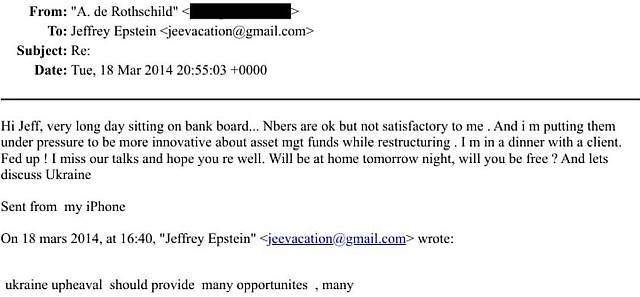
With Ukraine’s estimated $10-12 trillion in money-good collateral, there would indeed be “many opportunities, many”.